If your aging parent or spouse served in the United States military, they may have earned valuable benefits that can make senior living much more affordable. Yet, millions of veterans and their families miss out on this financial support simply because they do not know it exists—or they find the application process too confusing to navigate alone.
At Graceful Care Haven, we believe that those who served our country deserve the highest quality of care in their golden years. To help you understand your options, we have created this comprehensive, easy-to-understand guide to VA benefits for senior living.
Whether you are looking into assisted living, memory care, or in-home support, here is everything you need to know about using VA benefits to pay for senior care in 2026.
Find Out If You Qualify for VA Senior Living Benefits
Don’t miss out on the benefits you’ve earned through military service. Our experienced team at Graceful Care Haven can help you understand your senior care options, connect you with accredited Veterans Service Officers (VSOs), and guide you toward the resources available for assisted living, memory care, or in-home support.
Schedule Your Free ConsultationThe Direct Answer: Will the VA Pay for Senior Living?
The most common question families ask is: “Will the VA directly pay for my parent’s room and board in an assisted living facility?”
The direct answer is no. The U.S. Department of Veterans Affairs (VA) does not directly write a check to a senior living community to cover rent.
However, the VA does provide tax-free monthly pension augmentations—most notably the Aid and Attendance benefit—that go directly into the veteran’s bank account. The veteran or their family can then use this extra monthly money to pay for room, board, and personal care in a private assisted living facility, memory care unit, or for in-home care services.
Understanding the Aid and Attendance (A&A) Benefit
The Aid and Attendance (A&A) benefit is the most powerful financial tool available to wartime veterans and their surviving spouses. It is an “add-on” to the standard VA pension.
2026 Maximum Monthly Rates
For 2026, the VA has increased the maximum monthly payout for the Aid and Attendance benefit. The amounts you can receive are:
- Single Veteran: Up to $2,424 per month
- Married Veteran: Up to $2,874 per month
- Surviving Spouse: Up to $1,558 per month
- Two Married Veterans: Up to $3,845 per month
Note: The exact amount you receive is based on your family’s countable income and medical expenses. The VA subtracts your income from the maximum rate to determine your payout.
Medical Qualifications for A&A
To qualify for Aid and Attendance, a doctor must verify that the veteran or surviving spouse requires assistance with Activities of Daily Living (ADLs). You must meet at least one of the following conditions:
- You require help from another person to perform daily functions like bathing, dressing, eating, or using the bathroom.
- You are bedridden.
- You are a patient in a nursing home due to mental or physical incapacity.
- Your eyesight is limited (even with glasses, corrected visual acuity is 5/200 or less in both eyes, or your field of vision is severely restricted).
The Housebound Benefit
If your loved one does not need help with ADLs but is permanently disabled and substantially confined to their immediate home, they may qualify for the Housebound Benefit. This also provides an increased monthly pension. Important rule: You cannot receive both Aid and Attendance and Housebound benefits at the same time.
Who is Eligible for VA Senior Care Benefits?
Not every older adult who served in the military qualifies for the Aid and Attendance pension. The VA has strict guidelines regarding service history, medical needs, and finances.
1. Service Requirements
To qualify for a wartime pension, the veteran must meet the following service criteria:
- Served at least 90 days of active duty, with at least one day served during a recognized wartime period.
- Received a discharge that is other than dishonorable.
- Note: You do not need to have served in a combat zone, just during a recognized war era (e.g., WWII, Korean War, Vietnam War, Persian Gulf War).
2. Financial Requirements
Because this is a need-based pension, the VA looks at your income and assets.
- Countable Income: The VA looks at your household income. However, high medical expenses—like assisted living rent, prescription costs, and in-home care fees—can be deducted from your income to lower your “countable” income, making it easier to qualify.
- Net Worth Limit: In 2026, the maximum net worth limit for a veteran to qualify for a pension is $163,699. This includes assets like bank accounts, stocks, and bonds (but does not include the value of your primary home or car).
Types of Care Covered by VA Benefits
While the VA doesn’t pay the facility directly, the money from the Aid and Attendance pension can be used to pay for a wide variety of senior care options, including:
- Assisted Living Communities: Helping pay for an apartment where seniors get help with daily tasks, meals, and medication management.
- Memory Care: Specialized, secure facilities for seniors with Alzheimer’s or dementia.
- In-Home Care: Paying a visiting caregiver to help with bathing, dressing, and meal prep so the veteran can age in place.
- Adult Day Health Care: Daytime programs that provide health services and social interaction for seniors.
Direct VA Care Facilities
In addition to the pension, the VA operates its own care network. If a veteran is enrolled in VA Health Care, they may be eligible for:
- Community Living Centers (VA Nursing Homes): VA-operated facilities offering round-the-clock skilled medical and nursing care.
- State Veterans Homes: State-run facilities that often provide nursing care, assisted living, and memory care at a lower cost for eligible veterans.
- Home-Based Community Care: The VA can arrange for visiting personal care aides, physical therapy, and homemaker services.
VA Benefits vs. Medicare vs. Medicaid
Families often confuse VA benefits with Medicare and Medicaid. Here is a simple breakdown of how they differ:
- Medicare: Federal health insurance for seniors 65+. Medicare pays for short-term, acute medical care (like a hospital stay or a doctor’s visit) but pays $0 for long-term room and board in an assisted living facility.
- Medicaid: A state and federal program for low-income individuals. Medicaid can cover the cost of assisted living and nursing homes, but you must deplete most of your assets to meet strict state poverty limits.
- VA Benefits: Specifically for veterans. The Aid and Attendance pension provides cash directly to the veteran to pay for care, without requiring them to be completely destitute.
Bonus: In some cases, a veteran can qualify for both Medicare and Medicaid (Dual Eligibility), while also receiving VA benefits.
How to Apply for VA Senior Living Benefits
Applying for VA benefits can feel overwhelming, but you do not have to do it alone. Here is the step-by-step process to get started:
Step 1: Gather Your Documents
Before applying, collect the following paperwork:
- Your DD Form 214 (Discharge/Separation papers).
- A copy of your marriage certificate (if applicable).
- A copy of a death certificate (if applying as a surviving spouse).
- Financial information (bank statements, Social Security award letters, proof of income, and asset statements).
- A letter from your primary care doctor detailing your medical diagnoses, prognosis, and your need for assistance with daily living tasks.
Step 2: Fill Out the Correct Forms
You will need to submit specific VA forms depending on your situation:
- VA Form 10-10EZ: To enroll in VA Health Care.
- VA Form 21-527EZ: For veterans applying for the Aid and Attendance pension.
- VA Form 21P-534EZ: For surviving spouses applying for the pension.
Step 3: Get Free, Professional Help
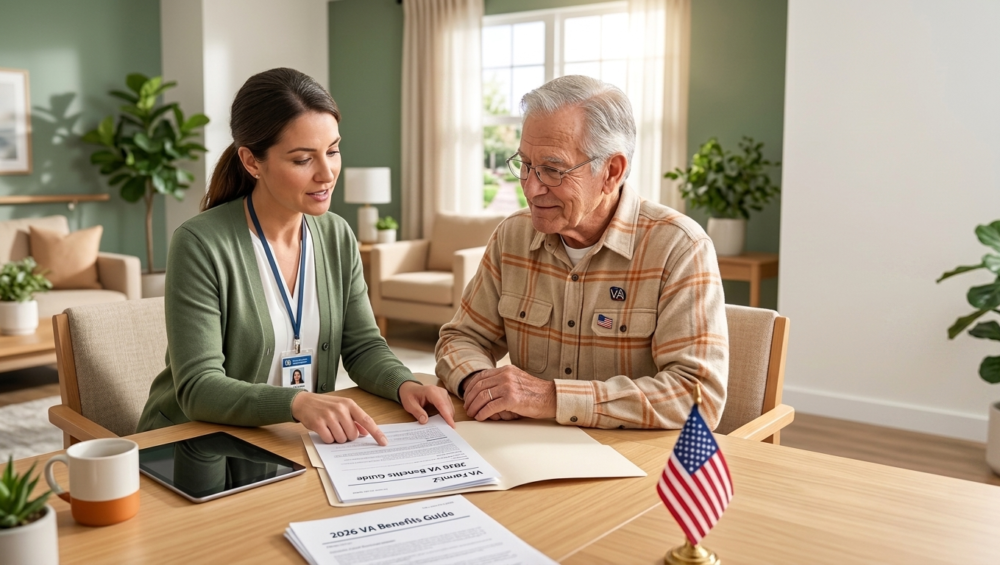
Do not try to navigate this process alone. The VA highly recommends working with a Veterans Service Officer (VSO). VSOs are trained, accredited professionals who will help you file your claim for free. They know exactly how to document medical needs and deduct care expenses to ensure your application is approved.
You can find an accredited VSO through organizations like the American Legion, VFW, or by contacting your local county VA office. You can also call the VA toll-free hotline at 800-698-2411.
Graceful Care Haven: Supporting Our Veterans
At Graceful Care Haven, we understand that navigating the financial side of senior care is stressful. We are deeply honored to care for veterans and their spouses in our communities.
While we are not affiliated with the VA and cannot guarantee pension approval, our knowledgeable team is here to help you understand your options. We can connect you with local accredited VSOs, help you organize the medical documentation you need, and explain how our care services align with the Aid and Attendance benefit rates.
If you are considering senior living for a veteran or surviving spouse, do not leave hard-earned money on the table. The VA Aid and Attendance benefit was created to ensure our heroes receive the dignified, compassionate care they deserve in their twilight years.
Contact Graceful Care Haven today to schedule a tour, speak with our care coordinators, and learn how we can help your family access the benefits you have earned through your service.
FAQs
No. The VA does not write checks directly to private assisted living or memory care facilities to cover room and board. Instead, the VA deposits the tax-free Aid and Attendance pension money directly into the veteran’s or surviving spouse’s bank account. The family can then use those funds to write a check to the facility.
For 2026, the VA Aid and Attendance benefit pays a maximum of $2,424 per month for a single veteran, $2,874 per month for a married veteran, and $1,558 per month for a surviving spouse. The exact amount you receive depends on your household income and how much you pay in out-of-pocket medical and care expenses.
To qualify, a veteran must meet three main requirements:
Service: Served at least 90 days of active duty, with at least one day during a recognized wartime period, and received a discharge other than dishonorable.
Medical: A doctor must verify they need assistance with Activities of Daily Living (ADLs) like bathing, dressing, or eating, or they are bedridden or have severe vision loss.
Financial: Their countable income and net worth must fall below the VA’s set limits (which is $163,699 for net worth in 2026).
The application process can take anywhere from 3 to 6 months (and sometimes up to a year) for the VA to process and approve a claim. However, once approved, the VA pays the benefit retroactively back to the date the application was submitted. Because of this delay, families often need to use private funds or bridge loans to cover the initial months of care.
Yes, but it depends on the program. The standard Aid and Attendance pension provides cash to the veteran, which they can use to pay a family caregiver (though spouses are often exempt from being paid in some states due to tax laws). Additionally, the VA offers the Program of Comprehensive Assistance for Family Caregivers (PCAFC), which provides a monthly stipend directly to family caregivers of post-9/11 veterans who have a serious service-connected disability.
Yes. The Aid and Attendance pension can be used to pay for specialized memory care in an assisted living facility or a dedicated memory care community, provided the veteran or surviving spouse meets the medical and financial requirements. The VA recognizes that Alzheimer’s and dementia require specialized custodial care.
VA Disability Compensation is a monthly tax-free benefit paid to veterans who were injured or became ill as a direct result of their military service. It is not based on income. VA Pension (including Aid and Attendance) is a need-based benefit for low-income wartime veterans who are 65 or older, or permanently disabled from non-service-related issues. You cannot receive both VA Pension and VA Disability Compensation at the same time; you must choose whichever pays more.
Yes. If a wartime veteran passes away, their unmarried surviving spouse may be eligible for the Survivors Pension with Aid and Attendance. In 2026, a surviving spouse can receive up to $1,558 per month to help pay for assisted living or in-home care, provided they meet the medical and financial requirements.