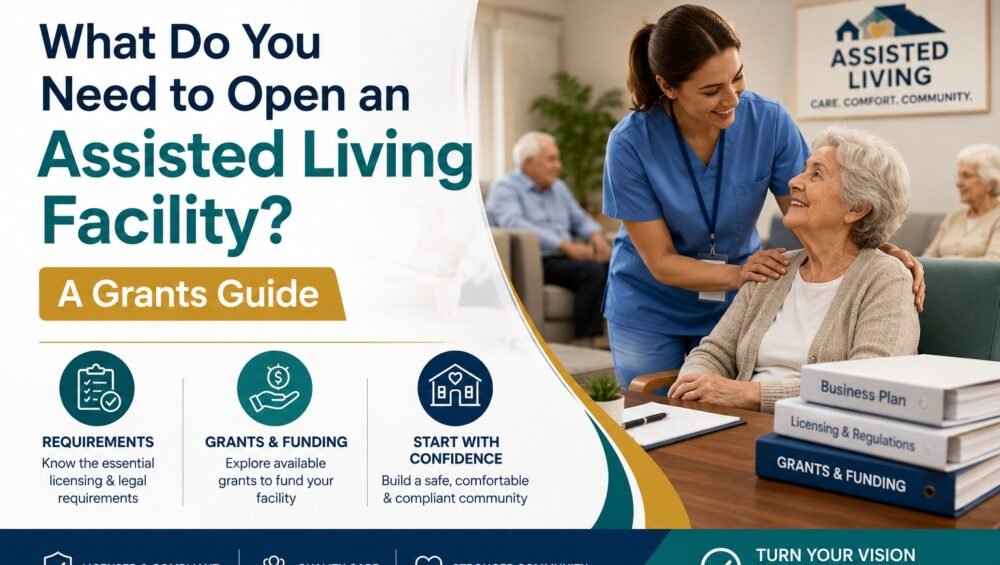
Opening an assisted living community requires more than just a brilliant idea and a passionate heart. It requires the right foundations that you can present to the authorities, financiers, and grant organizations. The majority of founders base their plans on five key foundations prior to submitting any license applications: business plan, state licensing and certification, staffing plan, liability insurance, and initial capital for renovations, furnishings, supplies, and payroll.
When founders operate within five key foundations, the license application process becomes simpler because all the authorities have to do is confirm what is already there. Also, it helps to involve the state licensing department at an earlier stage since they will review the plan even before an official submission.
Understanding the Costs Involved
The start-up costs depend on whether you are remodeling an existing building or constructing a new one, but all start-up cost budgets follow the same pattern. This is an example of a small facility budget:
| Cost Category | Typical Range | Notes |
| Licensing and permits | $2,000–$10,000 | Varies by state and facility size |
| Property acquisition or lease | $500,000–$3,000,000+ | Depends heavily on region and building condition |
| Renovation and ADA compliance | $50,000–$500,000 | Higher for older buildings needing structural updates |
| Furnishings and medical equipment | $20,000–$150,000 | Beds, lifts, emergency call systems |
| Staffing (first 6 months) | $150,000–$400,000 | Caregivers, nursing staff, administration |
| Insurance and legal fees | $10,000–$40,000 | Liability, property, and business formation |
These figures explain why so many first-time operators actively pursue grant funding rather than relying solely on personal savings or a single loan.
Federal Grant Programs to Explore
There exist various federal programs that provide financing options for assisted living founders to utilize in the creation of an assisted living facility, especially if the assisted living facility caters to the rural, poor, and veteran communities.
USDA Community Facilities Programs.
USDA provides essential community facilities in rural communities, and assisted living facilities fit well under this category. Grant and loan assistance from this agency is usually combined, thus greatly reducing financing costs.
HUD Section 232 Program.
This is a loan guarantee program as opposed to a grant program and greatly reduces financing risks to make private financing more accessible.
HRSA Grants.
The Health Resources and Services Administration provides periodic funding to support the development of health care access improvement programs in medically underserved communities.
State and Local Grant Opportunities
Additionally, there is the health department and economic development agency at the state level that keeps their own sources of funds which may be easily accessed because fewer people know of such programs than those at the federal level. You may consider contacting your state’s Department of Aging.
| Funding Source | Who It Targets | Typical Support |
| State Department of Aging grants | Facilities serving low-income seniors | Direct grants or per-bed subsidies |
| Economic development authority funds | Facilities creating local jobs | Tax credits, grants, or reduced-interest financing |
| Community Development Block Grants (CDBG) | Facilities in qualifying census tracts | Construction and renovation funding |
| Rural development offices | Facilities in designated rural zones | Grants paired with technical assistance |
Local funding also tends to move faster than federal programs, since review committees are smaller and application windows are typically less rigid.
Nonprofit and Private Funding Options
In addition to government programs, there are several foundations that offer financing for senior care projects with religious ties, veteran preference, or health mission. Foundations that have connections with hospitals in the region will finance such senior care projects as long as they accept patients under Medicaid and below market rate. CDFIs are institutions that offer financing and grants along with sub-market rate financing to social enterprise organizations that have a health mission.
Larger foundations could provide you with PRIs that look like loans but better because foundations do not operate for profit.
Tips for a Strong Grant Application
In most cases, the grant review panel is faced with numerous applications from many people all competing for a limited number of funds. The numbers themselves will not get you anywhere; your proposal has to make an impressive case.
Start with community needs.
Provide statistics regarding local demand for senior housing facilities.
Show the viability of the project.
Financial sustainability is something that the reviewers would like to see in the proposal.
Emphasize the experience of your group.
Experience of the operator is very important both for the licensing authority and for the grant reviewers.
Align your mission with the mission of the funder.
Generic proposals never do well against tailored ones.
Submit early, and, if necessary, re-submit your application.
Grants are submitted annually, and the reviewers may give helpful feedback for the second round.
How Graceful Care Haven Approaches Community-Focused Growth
Graceful Care Haven operates under one guiding rule: staff-to-resident ratios, amenities, and care plans must never be sacrificed because of funding limitations; instead, the budget should be designed based on the quality of care. This is the approach applied to assess all funding options, with the emphasis on those which will help create a high-standard care service rather than just increase the budget. This is the idea which many entrepreneurs mention when trying to decide on the future of their facilities after obtaining funding.
Whether you are in the preliminary stage of funding, or already trying to obtain financial sources, knowledge of what running the business requires and what grants are offered can become your basis for creating a sustainable business.
Frequently Asked Questions
Do I need a background in nursing to start an assisted living facility?
No. Most states mandate a licensed administrator to be employed by an assisted living facility, while some require an administrator’s training regardless of whether the owner is offering direct care services.
How long does the licensing process usually take?
Three to six months.
Can I use multiple grants for one project?
Often, yes, but it depends on each individual program because some do not allow combined funds to be used for one project.
Are grants available only for nonprofit facilities?
No. Grants may be granted to a for-profit facility as well, provided it is ready to accept Medicaid and/or low-income residents.
What is the most common mistake made by first-time grant applicants?
Submitting generic applications that do not fit the goal of a particular program.
Ready to Bring Compassionate Care to Your Community?
It is not an easy feat to design and build an assisted living community, but you will not be alone when it comes to dealing with the licensing, financing, and staffing issues. Graceful Care Haven is ready to discuss all aspects of senior care with the operators and families alike.